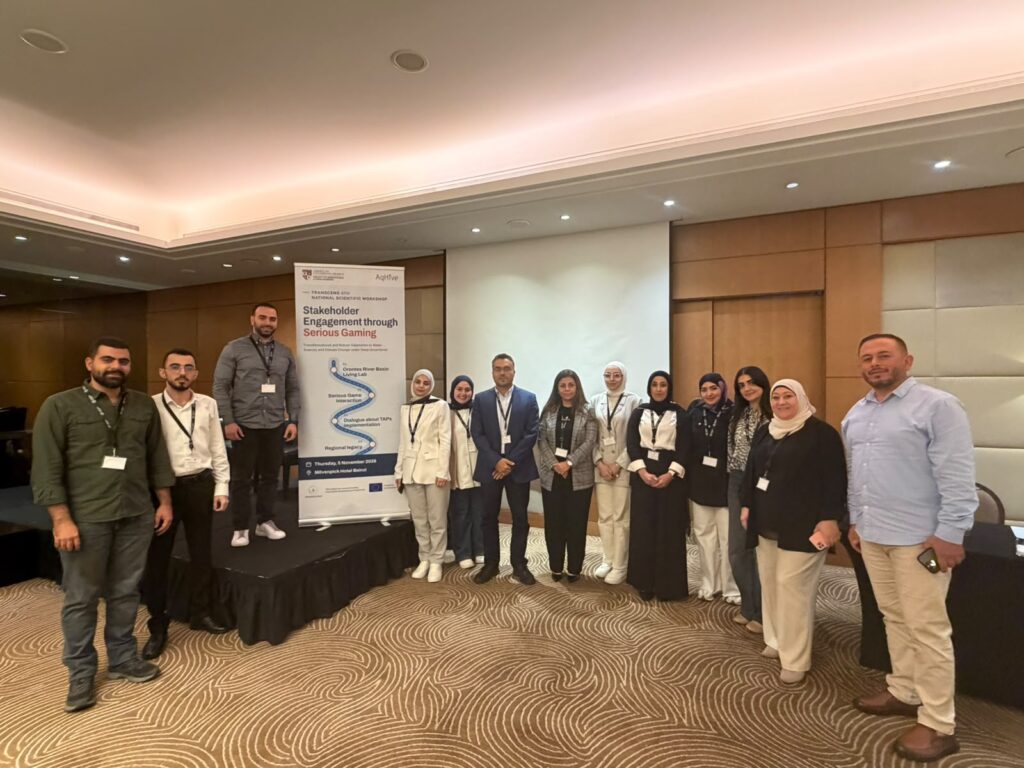
The 4th and final stakeholder workshop for the Orontes River Basin was held in Beirut, Lebanon, on 5 November 2026. It was organized by AgHive at the Department of Agriculture, Faculty of Agricultural and Food Sciences, American University of Beirut.
The workshop brought together representatives from the Ministry of Agriculture, the Ministry of Economy and Trade, the Ministry of Environment, the Lebanese Agricultural Research Institute (LARI), Water Establishments, NGOs, researchers, farmers and policy advisors.
The workshop first featured a presentation of the water accounting of the upper Orontes at Hermel: how much water the basin has, who consumes it, and what is left for Lebanon.
This was followed by the serious game, where participants acted as decision-makers for the northern and southern parts of the basin. They tested water policies such as reducing water use, water pricing and wheat subsidies, and weighed their effects on farmers’ income, wheat production, groundwater and river flow. Groups had to reach compromises to balance these outcomes, and saw how their choices affected the results, whether by saving more groundwater in the aquifer or by keeping farm income high. This gave them a clearer idea of how to manage the basin and which policies have the greatest effect.
A panel discussion followed on putting the TAPs into practice. Discussions focused on which institution should lead each policy, such as water pricing and wheat support, and how ministries, water establishments, municipalities and local authorities could share responsibilities. Participants agreed that transformational policies are difficult but possible. They pointed to better coordination between institutions, monitoring of water use through meters, licensing of wells, safe reuse of treated wastewater, and partnerships with the private sector.