
The webstival is an online meeting that replicates some aspects of traditional festivals, dedicated to the dialogue between scientists, stakeholders and society. In the TRANSCEND project, this event aimed to connect partners with policies and stakeholders across the 7 Living Labs, complementing other outreach and training event formats.

Agenda, Topics, and Recordings
The 2nd TRANSCEND Webstival took place on September 5, 2025, bringing together keynote speeches, panel discussions, technical presentations, and interactive sessions. This page provides an overview of the programme, the topics that were covered, and access to recordings and materials
Advancing investment in water resilience
The TRANSCEND community and project stakeholders gathered online for the 2nd TRANSCEND International Webstival, a highly collaborative event focused on advancing transformative adaptation policies and financing mechanisms for water resilience in the project’s pilot river basins.
The Webstival brought together key actors from policy, research and practice to align perspectives and accelerate the implementation of sustainable and just transitions in water systems.
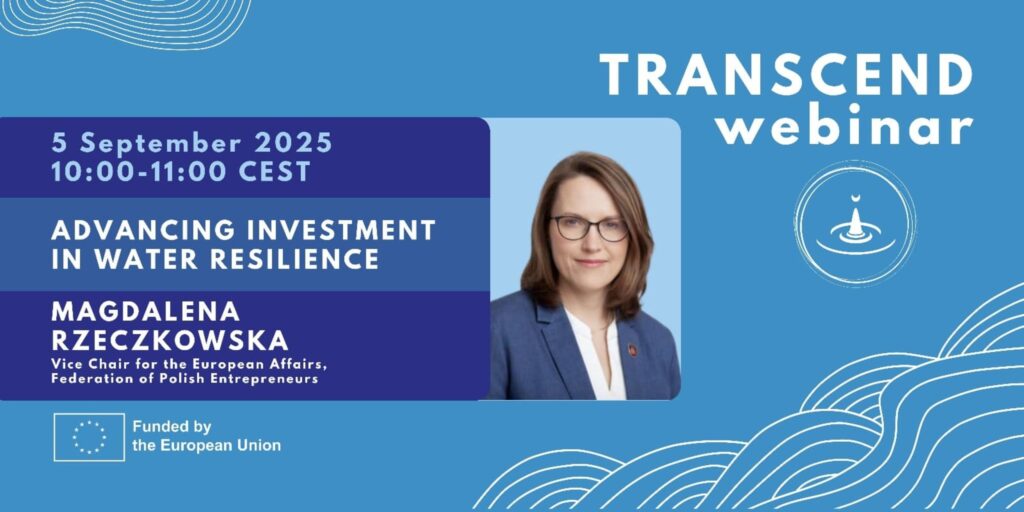
Keynote session – open webinar
The event opened with a keynote by Magdalena Rzeczkowska, Vice President for European Affairs at the Federation of Polish Entrepreneurs (FPP), titled: “Advancing investment in water resilience: a strategic pathway towards a water-smart society and economy” and it was based on this White Paper. The keynote framed the discussion by exploring how financial mechanisms can support nature-based solutions, equity and long-term sustainability in water management. This session was open to the public and held in webinar format.
Collaborative Sessions with project stakeholders
The second part of the Webstival marked its most interactive and practice-oriented moment, bringing together living labs experts and stakeholders in a structured exchange on financial mechanisms for water management. Building on the outcomes of the International Workshop (May 2025), the session aligned participants around a shared knowledge base before moving into a focused roundtable discussion.
At the core were six pitch presentations covering mechanisms tested or under evaluation across different river basins. These included payment schemes for ecosystem services within the regional water service in Emilia-Romagna, fiscal instruments for managing water resources under climate extremes in the Mahanadi basin (India), and financing models for agricultural water use in the Reno basin within the Aqua Virtuosa project. Additional contributions from the Nitra (Slovakia), Tympaki (Greece), and Litani (Lebanon) basins highlighted key barriers to adoption.
A central takeaway was that while financial mechanisms are diverse and often technically robust, their implementation is frequently constrained by regulatory, institutional, and socio-economic barriers. This underscores the need for context-sensitive approaches that adapt tools to local governance structures and capacities.
The Webstival concluded with a synthesis of the discussions and an outline of the project’s next steps, aiming to translate insights into concrete actions.