
Capacity Building for Water Resources, Remote Sensing, and Andean Agriculture in the TDPS Living Lab
As part of the TRANSCEND project, the second Summer School took place during the week of 12–18 October 2026 in Bolivia and Peru. It focused on the Latin America context based on the Living Lab of the transboundary Titicaca–Desaguadero–Poopo (TDPS) system shared by Bolivia and Peru. The regional partner Autoridad Binacional Autonoma del Sistema Hidrico TDPS (ALT) provided key support.
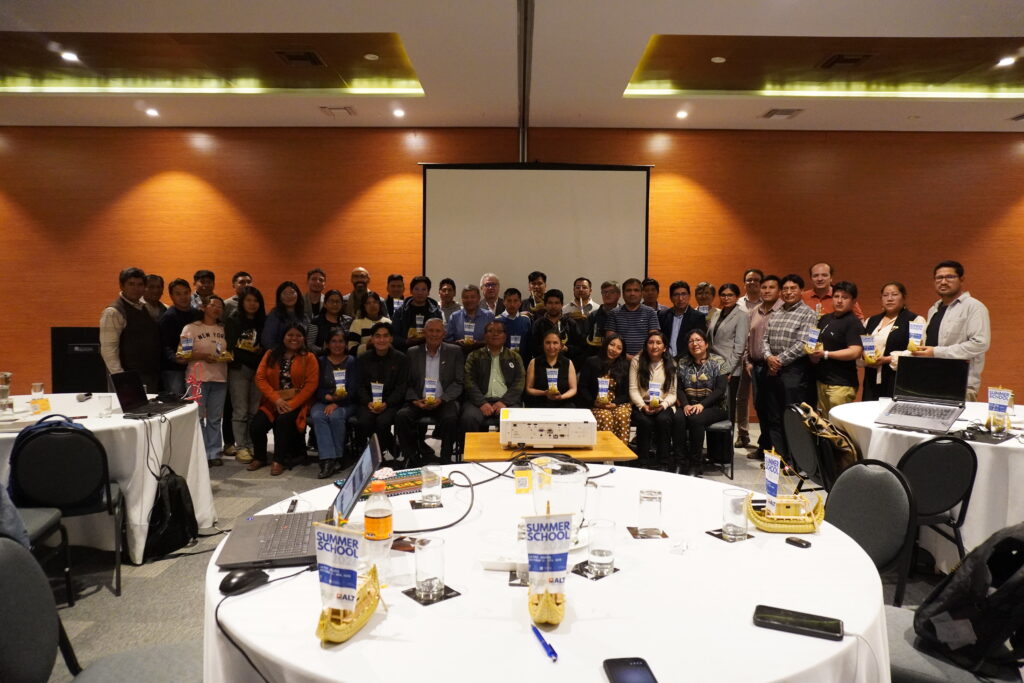
Approximately 40 participants from around 20 entities attended, including government agencies, local regulators, producers, and university representatives from Bolivia and Peru.
The program combined lectures (12–16 October) with field visits (17–18 October). Master classes covered:
a) Andean basin hydrology and WEAP modeling,
b) Remote sensing fundamentals, spectral indices, surface water monitoring (e.g., JRC products), water quality proxies, Google Earth Engine (GEE) processing, land use/land cover (LULC) classification, vegetation and water indices, and satellite altimetry,
c) Soil monitoring, irrigation efficiency, and smart irrigation for Andean crops such as quinoa.
Emphasis was placed on the potential of satellite data to characterize and monitor strategic water bodies (Lake Titicaca and Lake Poopó) and to track growth and production of key Andean crops (potato, quinoa, barley, alfalfa, and other pastures) supporting local and regional markets in both countries.
Materials and presentations were organized in a public GitHub repository.
Field visits examined irrigated and rainfed agricultural systems at different scales in Bolivia and Peru.
Discussions with participants identified challenges in regional water-use monitoring information and spatial monitoring of water bodies, alongside clear opportunities to apply the presented tools, methodologies, and concepts.
Emerging priorities included establishing more fluid communication channels for ongoing capacity transfer in tools such as AquaCrop and WEAP and strengthening local and regional monitoring platforms for Lakes Titicaca and Poopó through remote sensing. These themes generated strong interest and proposals to continue beyond the formal scope and timeline of TRANSCEND, as activities increasingly assimilated by local partners.
The course was organized by the Stockholm Environment Institute (SEI) in collaboration with the University of Manchester (UoM) and IMDEA. Local coordination involved the Universidad Mayor de San Andrés (UMSA/IIAREN) with additional contributions from PROSUCO program.